Brown Sugar Then and Now: How It’s Made and Why It Changed
Discover how brown sugar went from a less-refined cane sugar to the familiar pantry staple made today by combining refined crystals and molasses.
Opening scene
When I first started baking, I rarely kept brown sugar in the pantry because I used so little of it. By the time I needed it, the sugar had usually hardened into one solid mass. At one point, I tried breaking the clumps apart with a meat tenderizer. The bag split, and brown sugar scattered across the counter and onto the floor. I don’t recommend it.
Then I came across an article explaining that I could make a fresh batch myself with white sugar and molasses. I haven’t looked back. I can make it as light or dark as I want—a pound during the holidays or a single cup during a busy season when I’m baking less.
But that simple pantry solution left me with a larger question: if we make brown sugar from white sugar now, what did brown sugar mean before modern refining?
The short answer
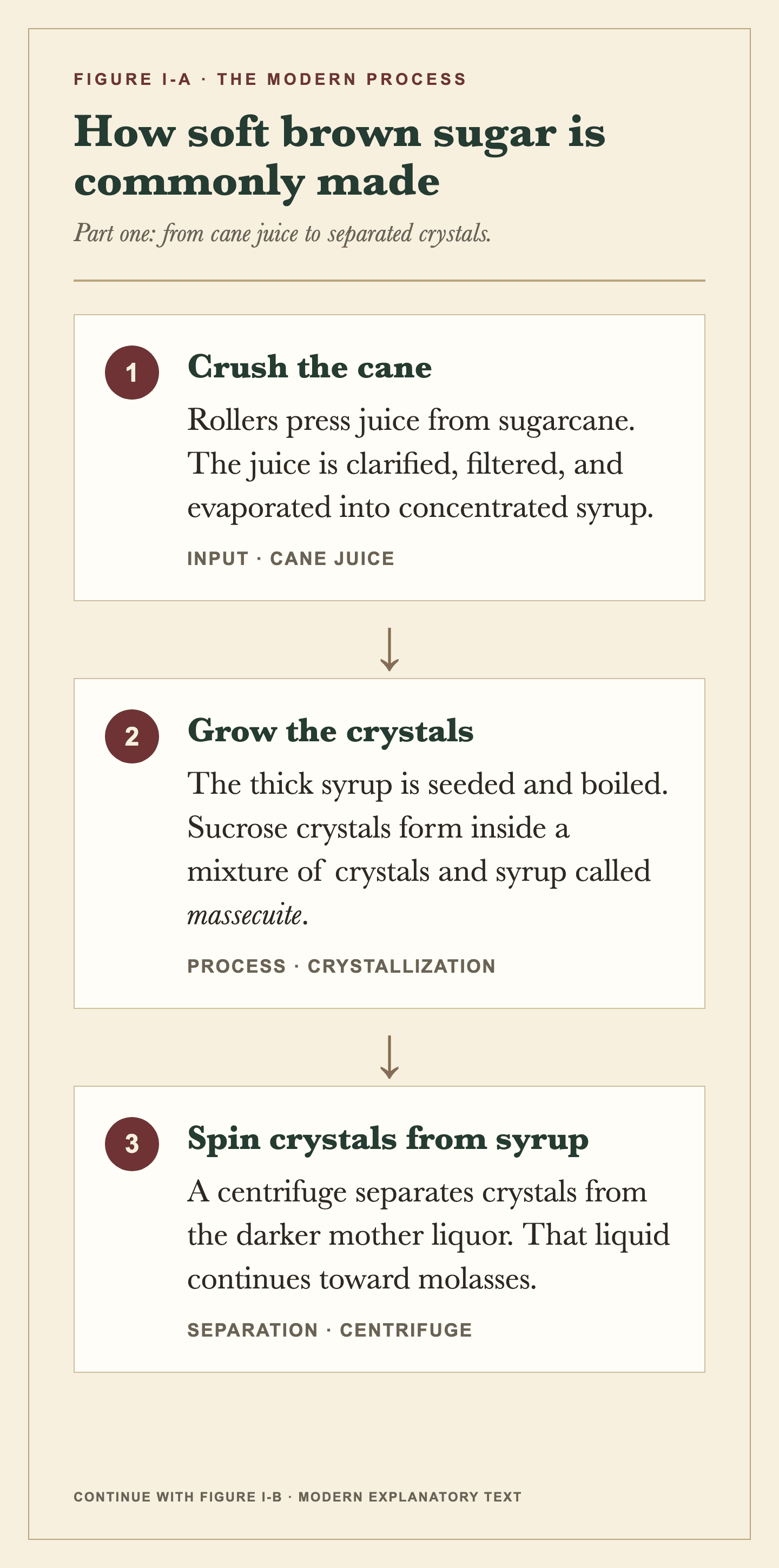
The short answer is: sort of. Not every sugar throughout history was brown, and historical muscovado was not identical to the soft brown sugar in our pantries today. Sucrose crystals themselves are white. But during older cane-sugar processing, the first sugar was often brown or golden because syrup, molasses, and other materials from the cane remained around the crystals. Making a paler sugar required more washing and refining.
Modern soft brown sugar often travels in the opposite direction. A producer begins with refined crystals and gives them a measured coating of cane-molasses syrup. Other producers crystallize brown sugar directly from selected brown and yellow syrups, so there is no single method used everywhere. Still, the familiar bag of soft light or dark brown sugar often owes its color and moisture to molasses added after refining.
From cane to crystals
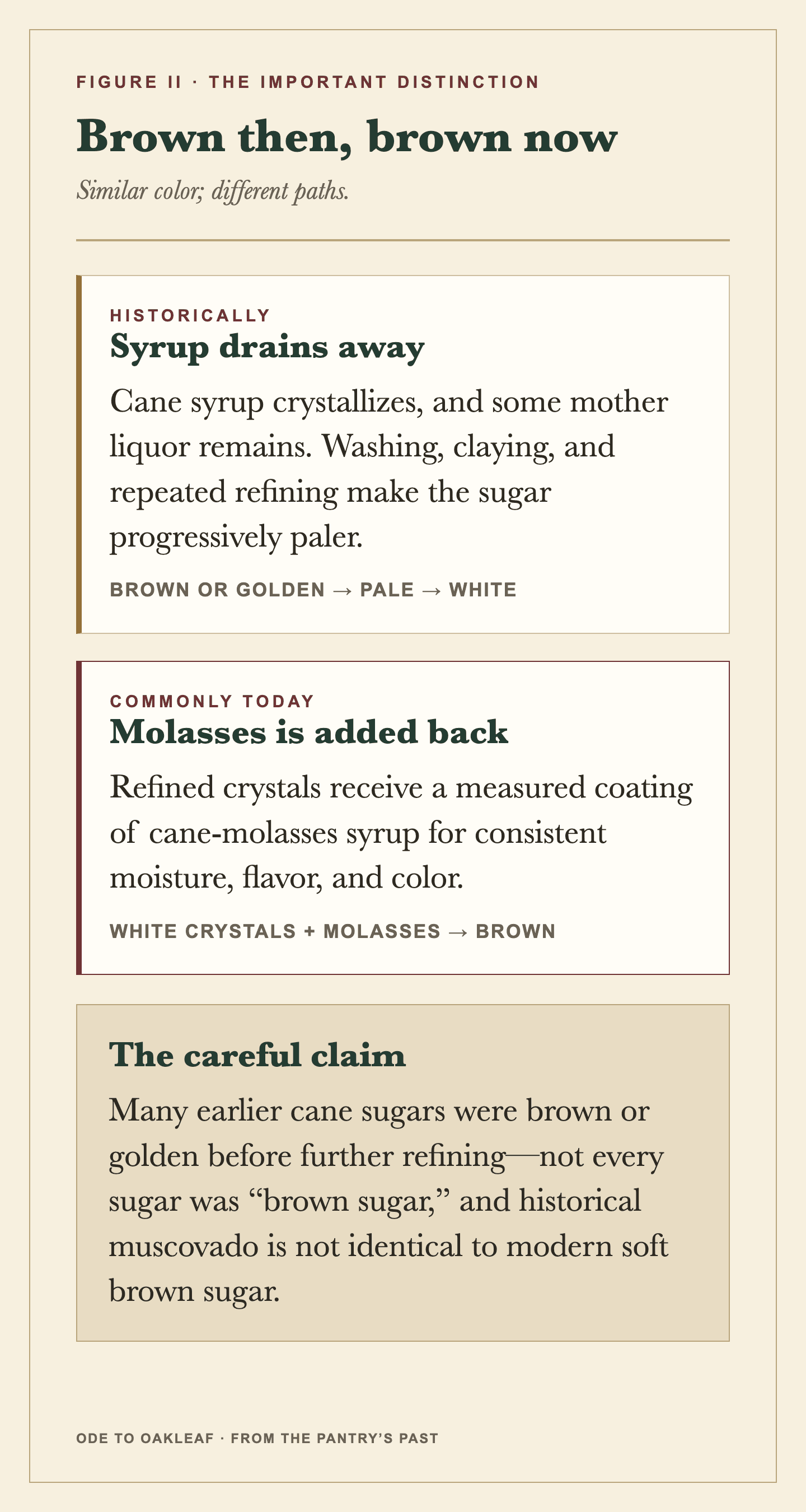
Brown sugar begins much farther from the pantry than a jar of molasses and a bowl of white sugar. It begins inside a stalk of sugarcane.
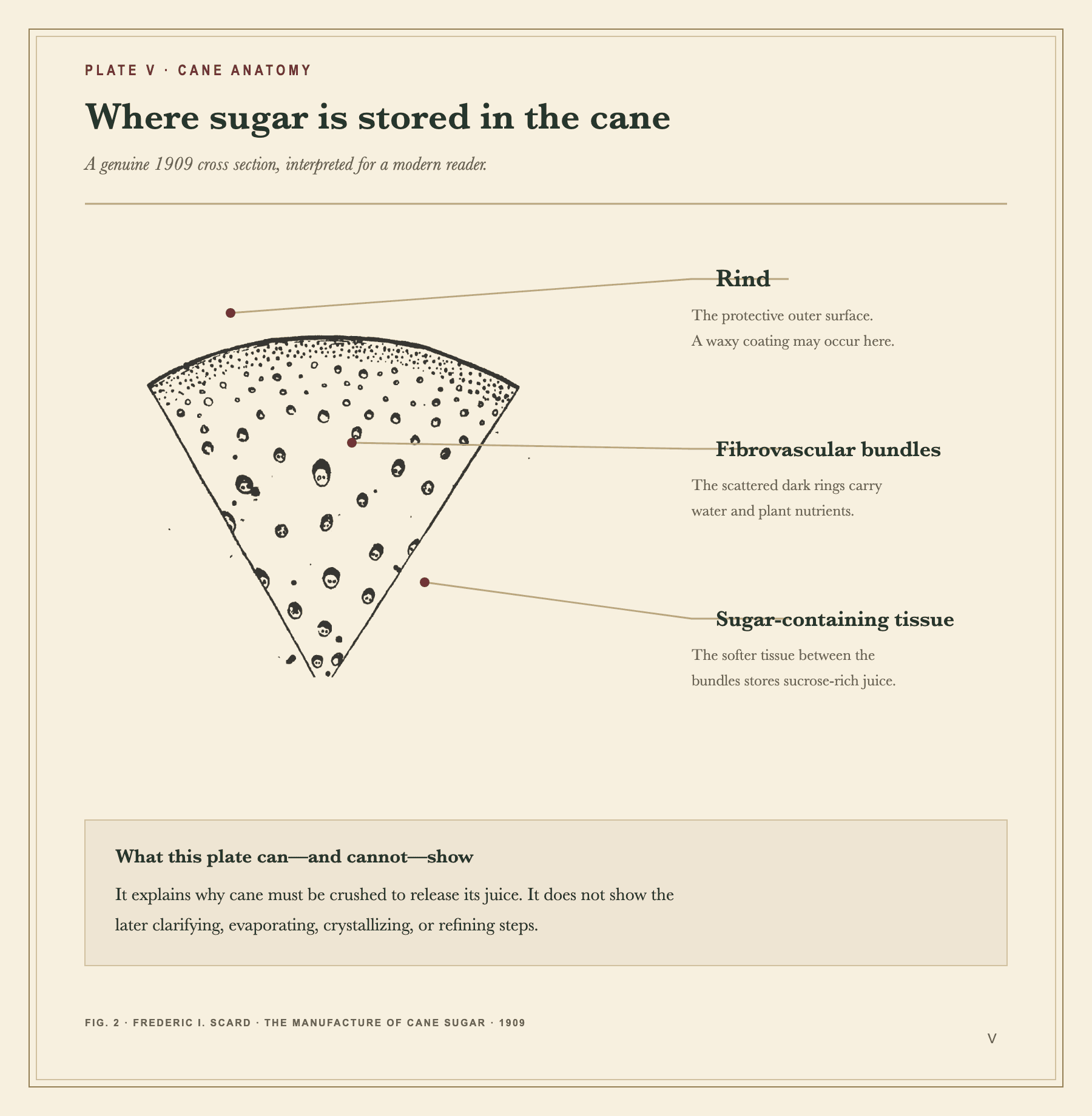
At the mill, the cane is cut and crushed—or passed through a diffusion system—to release its juice. That juice contains sucrose, water, bits of plant material, and other dissolved substances. It is clarified and filtered, then heated so that much of the water evaporates and the juice becomes a thick syrup.
The syrup moves into a vacuum pan, where it can boil at a lower temperature. Fine “seed” crystals give dissolved sucrose somewhere to gather. As the crystals grow, they remain suspended in a dense mixture of crystals and syrup called massecuite. It looks nothing like the loose sugar in a canister yet.
Process reference: Encyclopaedia Britannica, “Sugar: Crystallization and Refining.”
A centrifuge then spins the massecuite at high speed. The crystals stay in the basket while the darker liquid is forced away. That remaining liquid is called the mother liquor. After repeated rounds of crystallization, the syrup left behind becomes molasses. Later rounds generally produce darker, stronger molasses; the final material is commonly called blackstrap.
This is one reason the phrase “molasses is extracted and added back” can be confusing. Molasses is not a brown dye hidden inside a white crystal. It is the concentrated syrup left after crystals have been separated from cane juice.
How white sugar becomes white
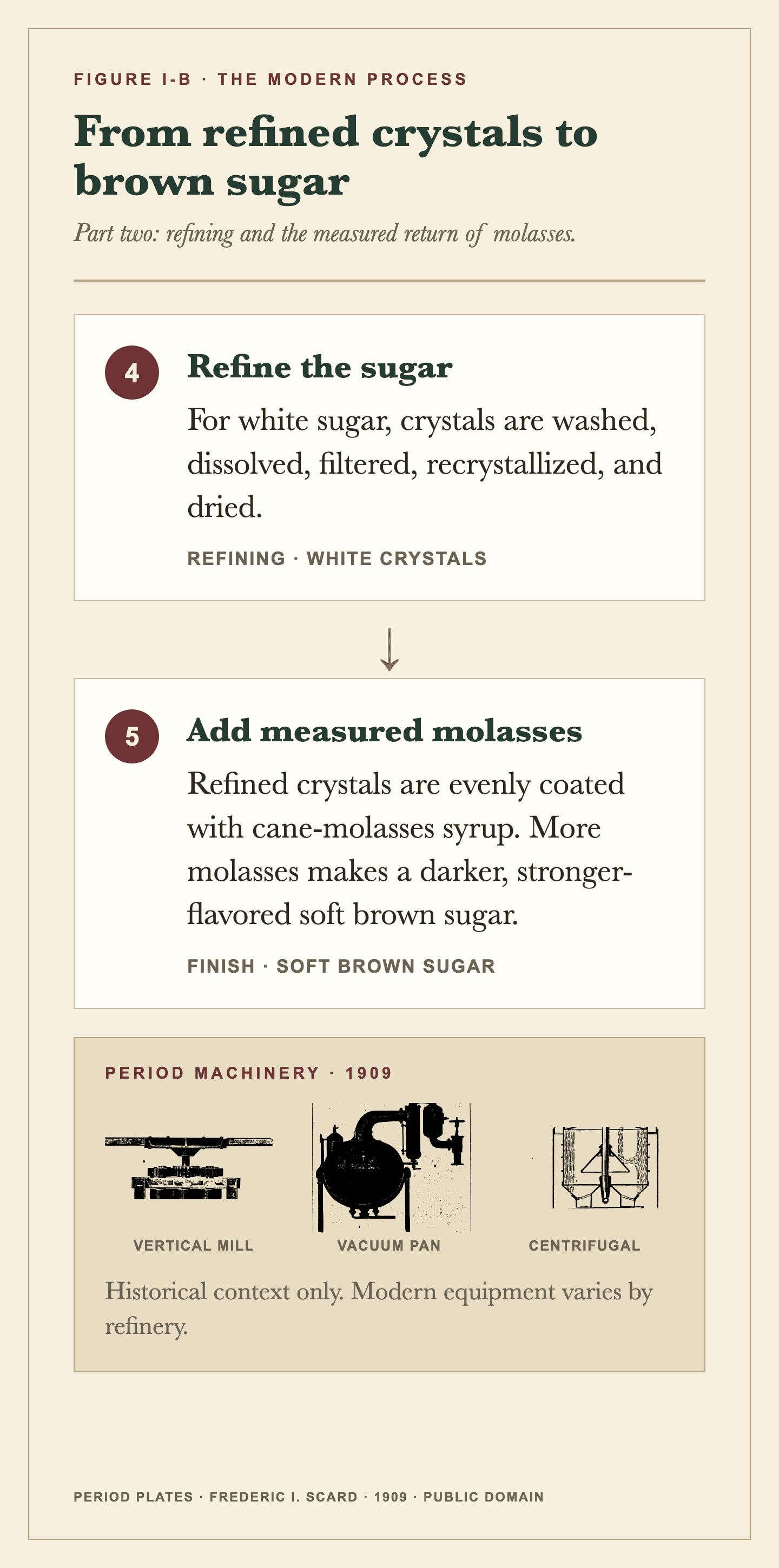
The pale brown or golden crystals from a cane mill can be sent to a separate refinery. There, the surface syrup is loosened and washed away. The crystals are dissolved again, and the liquid is clarified, filtered or decolorized, concentrated, crystallized, separated, and dried.
That sequence can sound needlessly roundabout until you remember that refining is about control. Re-dissolving the crystals allows the refinery to remove more of the remaining non-sugar material and produce a consistent, neutral-tasting white sugar.
A sugar mill and a sugar refinery are not always the same place. Cane is often processed near the fields because freshly cut cane deteriorates quickly. Raw sugar can then travel elsewhere for further refining. Beet sugar follows a somewhat different route and is commonly processed into white sugar in one facility.
Once those refined crystals exist, a manufacturer can make a consistent soft brown sugar by coating them with a controlled amount of cane molasses. Light and dark brown sugar are not two entirely different ingredients: dark brown sugar generally contains more molasses and has a stronger flavor, greater moisture, and deeper color. Exact formulas vary by producer.
Brown before white
This is where the title needs its caveat. Brown sugar was not invented on a certain afternoon, and there was never a period when every kind of sugar was literally brown. What we can say is that brown or golden cane sugar often appeared earlier in the refining process. Whiter sugar required more work.
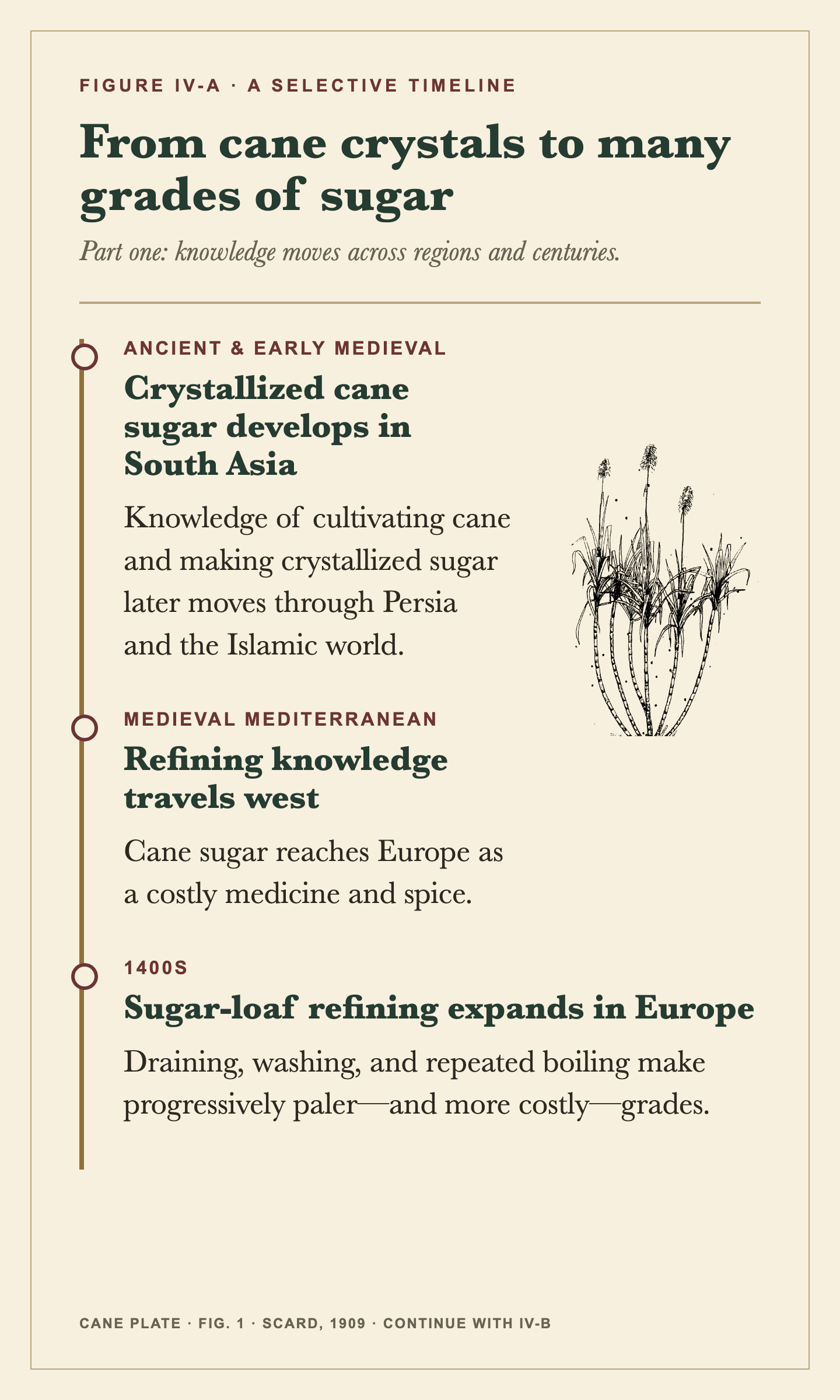
Methods for crystallizing cane sugar developed in South Asia and moved through Persia and the Islamic world. Sugar reached medieval Europe through trade and was treated as a costly spice or medicine rather than an ordinary baking staple. Early forms could be gritty or gravel-like. Over time, refiners learned to separate more syrup and color from the crystals and to make hard, pale loaves.
Color became a rough sign of refinement. A darker muscovado had more syrup and other cane material remaining. A paler loaf had been washed and refined more thoroughly. That did not make every dark sugar identical, but it did create recognizable commercial grades—and a hierarchy in which the whitest sugar usually cost the most.
Brown was often a stage along the way. White was the result of taking the process further.
Sugarloaves, claying, and the work of refinement
Before granulated sugar arrived in neat paper bags, refined sugar was commonly sold as a sugarloaf: a hard cone with a rounded top. Refiners poured a mixture of syrup and crystals into an inverted conical mold. A hole at the tip allowed darker syrup to drain into a pot below.
To make the loaf paler, workers could place damp clay over the broad end of the mold. Water moved slowly through the sugar, carrying more color and syrup downward. Later refiners used other washing solutions, but the principle was similar: remove more of what surrounded the crystals without dissolving the whole loaf.
After drying, the loaf still was not ready to pour. A household might use sugar nippers to break off pieces, then pound or grate them for cooking. The white crystals we now scoop without thinking once represented repeated boiling, draining, washing, drying, breaking, and grinding.
The labor of refinement helps explain why white sugar became a status symbol. It also helps explain why historical “brown sugar” should not be pictured as a tidy modern blend. It was part of a changing range of cane products, made with different tools, at different degrees of refinement.
Two windows into the historical record
A 1636 cargo record
One of the clearest pieces of evidence is wonderfully ordinary: shipping paperwork. A bill of lading dated October 6, 1636, records chests of sugar traveling from Lisbon to London aboard the Mayflower of London. The cargo distinguishes between “Muscouado” and “white” sugar.
That small wording choice tells us something important. Merchants already recognized them as separate grades. Brown or rawer sugar and refined white sugar existed side by side in trade. The record does not prove that all earlier sugar was brown, but it does show that color and refinement mattered commercially by the seventeenth century.
A 1772 Philadelphia advertisement
More than a century later, Philadelphia merchant William Coats advertised “loaf, lump, and muscovado SUGARS” at the sign of the Sugar-Loaf. The notice appeared in 1772—three years before Jane Austen was born.
For a modern shopper, “sugar” sounds like one basic pantry ingredient offered in different package sizes. Coats’s list gives us a glimpse of a different shelf: hard refined loaves, lumps broken from them, and darker muscovado, each carrying clues about how much work had gone into it and how it might be used.
How brown sugar changed
Early cane sugars were less uniform than the products we buy today. After cane juice was clarified, boiled, and crystallized, some molasses remained around the crystals, giving the sugar its brown or golden color and deeper flavor.
As refining methods improved, producers became better able to separate the molasses from the sugar crystals. This produced paler, more consistent sugar and eventually the refined white sugar familiar today.
Modern soft brown sugar often follows a different path. Manufacturers begin with refined sugar crystals and add back a controlled amount of molasses. That is why today’s light and dark brown sugars can be produced with such consistent color, moisture, and flavor.
Why homemade brown sugar works
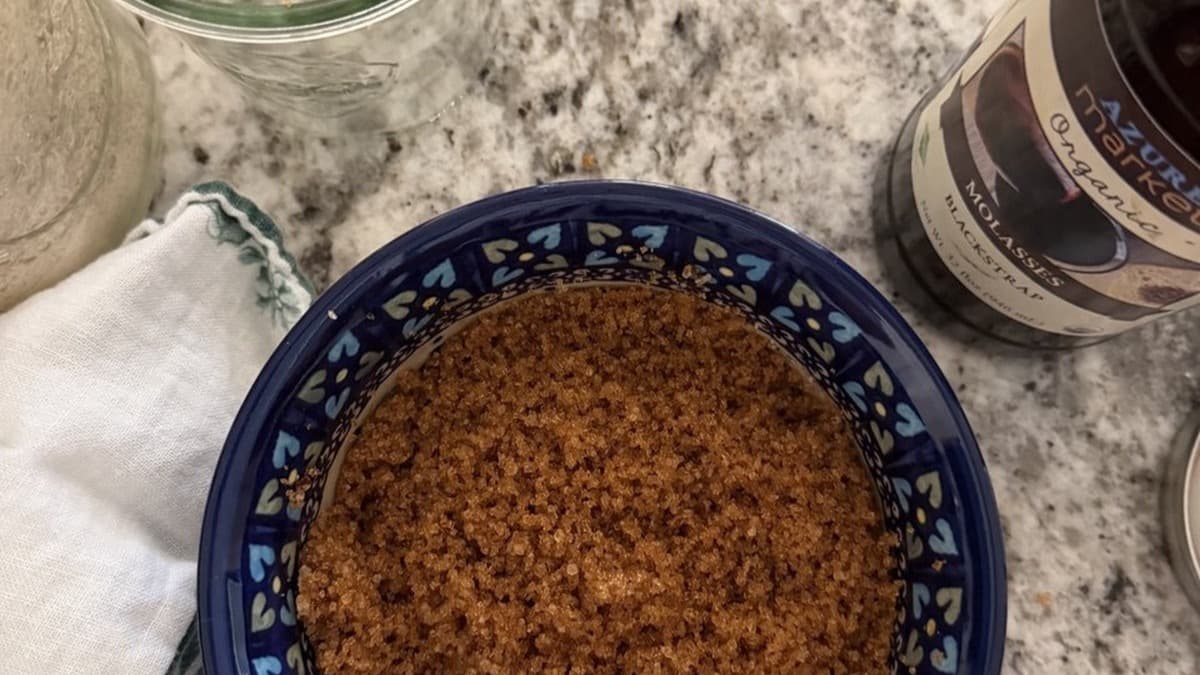
Back in my kitchen, the process is far less dramatic. I combine refined white sugar with cane molasses until every crystal is evenly coated. That recreates the basic composition of a common modern soft brown sugar, which is why the homemade version works so well in cookies, sauces, quick breads, and holiday baking.
Molasses changes more than color. It brings water, acidity, invert sugars, and a deep caramel-bitter flavor. Those qualities help brown sugar hold moisture and contribute to the soft, chewy texture we expect in many baked goods. They are also why a spoonful of dark brown sugar does not behave exactly like the same amount of dry, white granulated sugar.
The advantage of making it yourself is not that it is more historically authentic. It is that you can make exactly what you need. A smaller amount of molasses gives you a lighter, gentler sugar. More makes it darker and stronger. Most importantly, it is fresh—no meat tenderizer required.
Make the recipe: Homemade Brown Sugar
Six cane sweeteners that are often confused
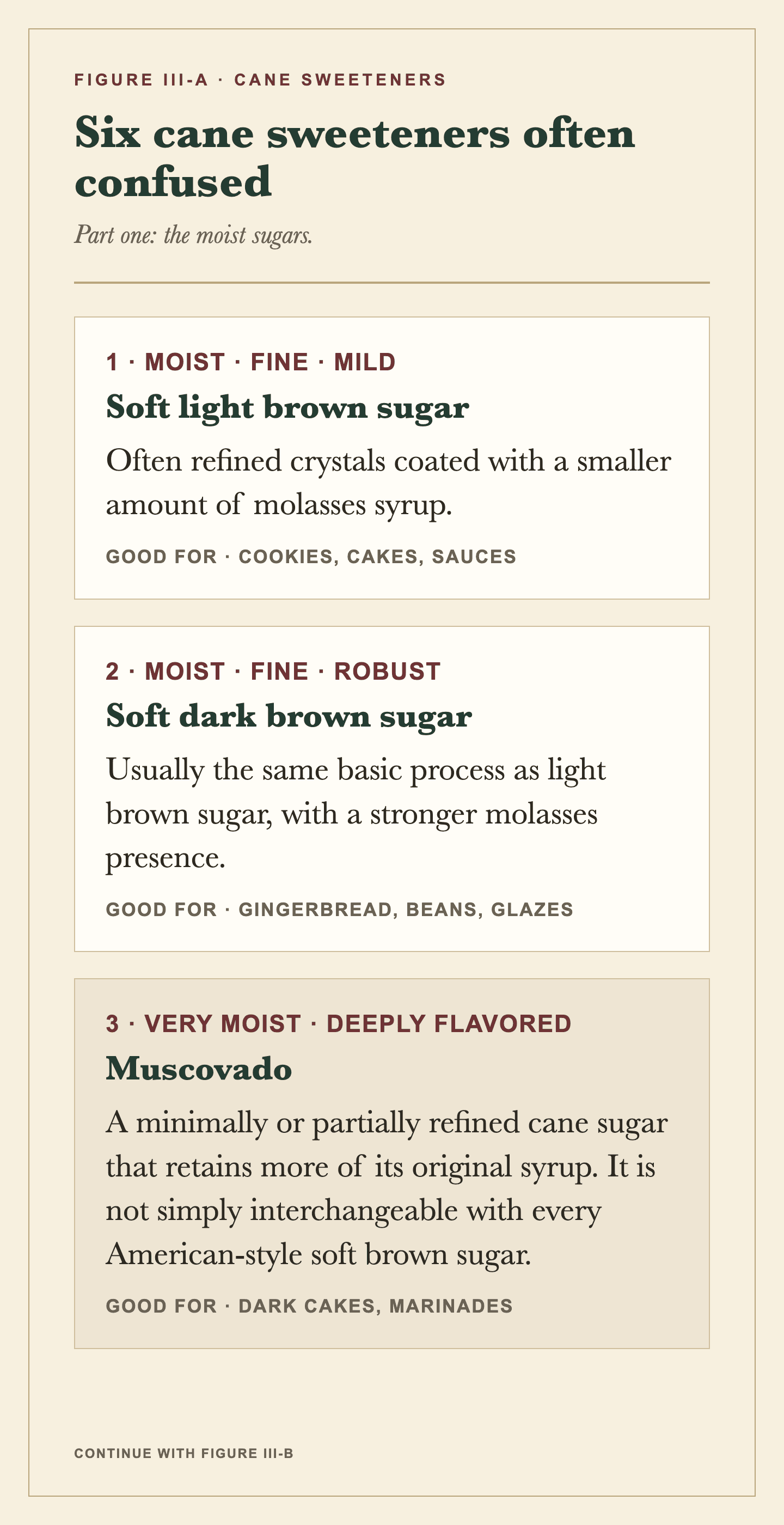
The brown-sugar aisle has become more interesting, but the names can make it sound as though every tan or brown cane sweetener is interchangeable. They are not. Moisture, crystal size, acidity, and flavor can all change the way a recipe turns out.
Soft light and dark brown sugar
These are the familiar moist sugars called for in most American baking recipes. They are commonly refined crystals coated with molasses syrup, although some manufacturers crystallize them directly from brown syrups. Dark brown sugar generally contains more molasses than light brown sugar, giving it a stronger flavor and deeper color. When a recipe depends on precise moisture or spread, use the type it requests.
Muscovado
Muscovado is a moist, minimally or partially refined cane sugar that retains more of its original mother liquor. It tends to be sticky, deeply flavored, and less uniform than ordinary soft brown sugar. It can be wonderful in gingerbread, dark cakes, marinades, and sauces, but it is not automatically interchangeable in every recipe.
Turbinado and demerara
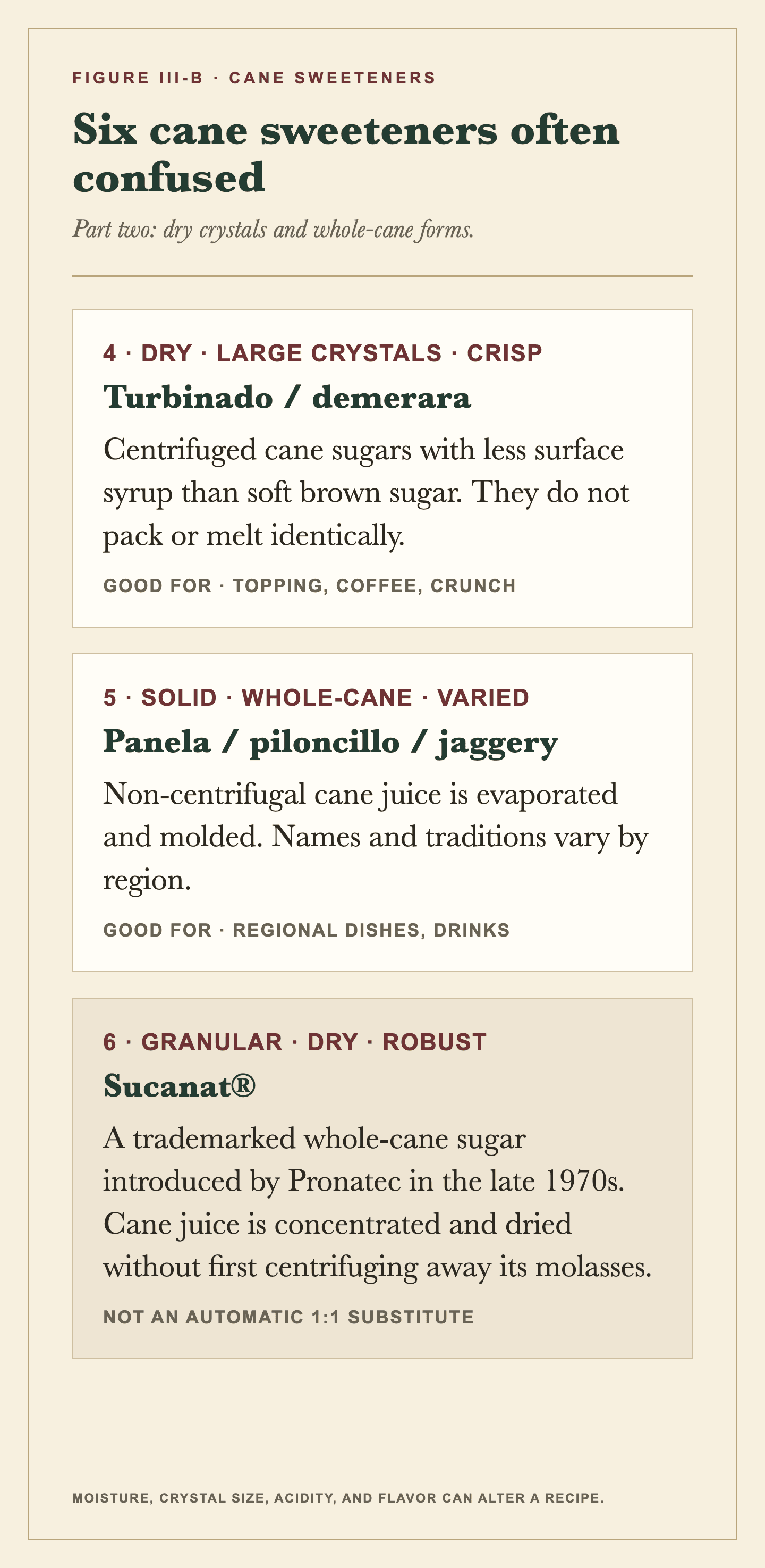
Turbinado and demerara have large, dry crystals with less surface syrup than soft brown sugar. Their crunch makes them useful on muffins, cookies, and pie crusts, or stirred into coffee. Because they do not pack, dissolve, or melt in quite the same way, they are usually a poor direct substitute when a recipe depends on soft brown sugar for moisture.
Panela, piloncillo, and jaggery
These names refer to regional traditions rather than one perfectly uniform product. Generally, cane juice is concentrated without centrifuging away the molasses, then poured into cakes, cones, or blocks. Flavor, color, and texture vary by place and method. These sweeteners belong in their own culinary traditions, not merely in a list of substitutes for an American bag of brown sugar.
Sucanat
Sucanat is a trademarked name for a granular whole-cane sugar developed by Pronatec in the late 1970s. Its name comes from sucre de canne naturel. Cane juice is concentrated and dried into irregular granules without first separating the molasses in a centrifuge.
Product references: Pronatec’s company history and America’s Test Kitchen’s process explanation. Company health claims are not adopted here.
That places it conceptually closer to whole-cane products such as panela or jaggery than to modern soft brown sugar, although its granular texture makes it look more familiar to shoppers. It tastes robust and is drier and coarser than packed brown sugar, so it can change a bake’s texture and spread. It also remains an added sugar. Retaining some molasses does not turn it into a whole food or make it nutritionally comparable to the cane plant it came from.
Back to the jar
I started making brown sugar because I was tired of finding a brick in the pantry. I kept making it because the process gives me exactly what I need and nothing more.
Now, when white sugar and molasses come together in a bowl, I see more than a shortcut. I see the long work of separating syrup from crystals, the old pursuit of a whiter loaf, and the many cane sugars that developed along different paths.
If you have molasses in the pantry, make a small batch. Notice how the dry crystals change as you work the syrup through them: the color deepens, the scent opens up, and the sugar begins to hold together under the spoon. Then bake something familiar—and keep the meat tenderizer in its drawer.
Sources and fact-check notes
1 Encyclopaedia Britannica, “Sugar: Crystallization and Refining.” Modern crystallization, centrifuging, refining, molasses, and brown-sugar production methods.
2 Encyclopaedia Britannica, “Cane Sugar.” Overview of cane-juice extraction, clarification, evaporation, crystallization, and separation.
3 The Sugar Association, “Sugar Refining & Processing.” Mill-versus-refinery distinction and general modern process. Industry source; use alongside Britannica.
4 The Sugar Association, “What Is Molasses?” Separation of molasses from crystals and common food uses of cane molasses.
5 The British Museum, “The Story of Sugar in 5 Objects.” Sugar in medieval England, earlier gritty forms, sugarloaf technology, and trade.
6 The National Archives (UK), 1636 bill of lading, catalogue HCA 30/840/79 f.189. Primary record naming “Muscouado” and “white” sugar.
7 The Encyclopedia of Greater Philadelphia, “Sugar and Sugar Refining.” William Coats’s 1772 advertisement and Philadelphia refining history.
9 Pronatec, company history of Sucanat. Brand history and the development of its whole-cane drying process. Company source; health claims are not adopted in this article.
10 Cook’s Illustrated / America’s Test Kitchen, “Sugar Types.” Practical distinction between light and dark brown sugar, storage behavior, and the tested white-sugar-and-molasses substitute.
11 Frederic I. Scard, The Manufacture of Cane Sugar, 2nd ed. (1909). Public-domain period illustrations used in the visual aids.
12 USDA Commercial Item Description: Sugars, Refined White and Brown. Finished-product standards and terminology.
Around the table
Questions, notes, and kitchen discoveries
Tried this recipe, changed something, or ran into trouble? Share what happened so we can learn from one another.
Enjoyed this story?
Receive new recipes, useful questions, and honest notes from the working kitchen.